Gantry Crane Parts: The Anatomy of a Portable Gantry
A portable gantry crane has five structural part groups: the beam (the horizontal bridge the load hangs under), the trolley (the carriage that rides the beam and carries the hook point), two A-frame leg assemblies with diagonal bracing, the height-adjustment hardware that pins the beam at working height, and the casters it rolls on. A chain hoist — hung from the trolley — completes the lifting system.
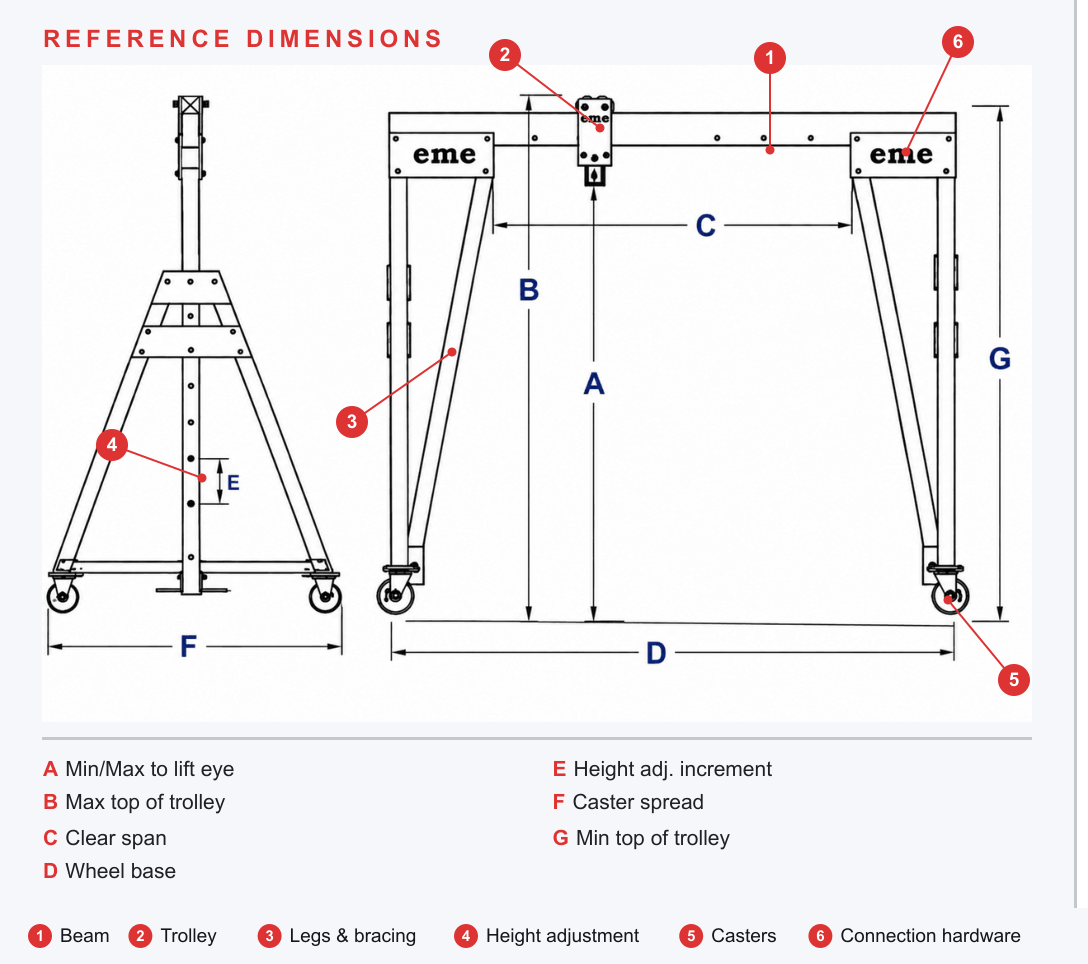
Side and front views from the published gantry spec sheet. Numbered callouts mark the six part groups covered below; the lettered callouts (A–G) are the dimensions — lift-eye range, top-of-trolley heights, clear span, wheel base, height-adjustment increment, and caster spread — listed per model on the sheet.
The beam
The beam is the bridge: a single horizontal girder the entire rated load hangs beneath. eme beams are proprietary 6061-T6 aluminum box extrusions — a closed rectangular section chosen because a box resists twisting far better than an open I-shape, which matters on a crane that moves. Capacity classes use progressively deeper beam sections; the beam is always a single girder, never a doubled pair. Beam length sets the span, and end stops at each tip keep the trolley captive.
The trolley
The trolley is the moving carriage that positions the lift point along the beam. eme uses a surround-beam trolley: it wraps around the box beam and rides on top of it, with the load shackle hanging below — so the trolley cannot come off the beam in service. eme trolleys are made specifically for eme beam profiles and are available only as part of the gantry line — not as standalone accessories for other beams. They come in three families shared across the line: one for the 1100/2200/4400 series, one for the 6600/11000, and a dedicated heavy trolley for the 22000 — which is why fleets running neighbouring capacities stock fewer spares.
Legs and bracing
Each end of the beam sits on an A-frame leg assembly: two angled uprights with diagonal braces, spreading the load into a wide, stable stance. The A-geometry is what lets a freestanding crane resist the small side loads of real-world rigging without being anchored to the floor.
Height adjustment
Portable gantries adjust working height in fixed increments — the beam assembly pins to the legs at the selected position. That is how one crane passes under a low doorway, then works at full height inside. Adjustment hardware is load-path structure: pins seat fully or the crane is not at working configuration.
Casters
Four swivel-locking casters put the crane on wheels. eme gantries roll on phenolic casters — hard, non-marking wheels suited to concrete floors — sized to the series, and rated so the crane can roll while fully loaded on level, prepared surfaces. Locks set, the crane is a fixed lifting frame; locks off, the lift travels. How loaded travel works covers the conditions.
Connections and hardware
Beam-to-leg joints carry the structure’s loads through bolted connections with structural-grade fasteners. On an aluminum crane the hardware is part of the engineering: fastener grade, joint design, and pin fit are specified on the engineer-stamped drawing that ships with every unit, alongside its Certificate of Test from the 125% factory load test — how load testing works.
The hoist that completes it
The gantry provides structure and mobility; the lifting itself is done by a hoist — usually a manual or electric chain hoist — hung from the trolley’s shackle. Hoists are governed by their own standard (ASME B30.16), separate from the crane structure’s ASME B30.17. Size the hoist to the crane’s rated capacity, never above it.
Part by part: what each one does
| Part | Job | Look at during inspection |
|---|---|---|
| Beam | Carries the load across the span | Straightness, dents or gouges, end-stop condition |
| Trolley | Positions the lift point; carries the shackle | Wheel wear, smooth travel, shackle and pin condition |
| A-frame legs | Spread the load to the floor | Brace connections tight, no bent members |
| Height pins | Lock the beam at working height | Fully seated, undamaged, correct hardware |
| Casters | Mobility; locks make it a fixed frame | Wheel condition, swivel action, locks hold |
| Fasteners | Carry loads through every joint | Present, tight, no substitutions |
| Hoist (separate) | Does the lifting | Per the hoist manufacturer and ASME B30.16 |
Every part above appears on the stamped general-arrangement drawing shipped with the crane — the authoritative reference for your unit. For the full product line, see portable aluminum gantry cranes.
Frequently asked questions
What are the main parts of a gantry crane?
Five structural groups — beam, trolley, two A-frame leg assemblies, height-adjustment hardware, and casters — plus the chain hoist that hangs from the trolley and does the lifting. On portable aluminum gantries the structure assembles from these components with hand tools.
Does a gantry crane come with the trolley?
A complete eme crane configuration includes the beam and its matched trolley — the trolley is part of the crane, not a separate accessory. The hoist is separate equipment, sized to the crane’s rated capacity.
What part of a gantry crane carries the load?
The whole load path does: hook to hoist, hoist to trolley shackle, trolley to beam, beam into the legs, legs into the casters and floor. A crane is rated as a system — which is why every eme unit is load-tested to 125% of rated capacity as an assembled crane, not as parts.
eme has been engineering lightweight and portable lifting equipment since 2003.